The exposome: attempting to measure what genes don't tell us about health
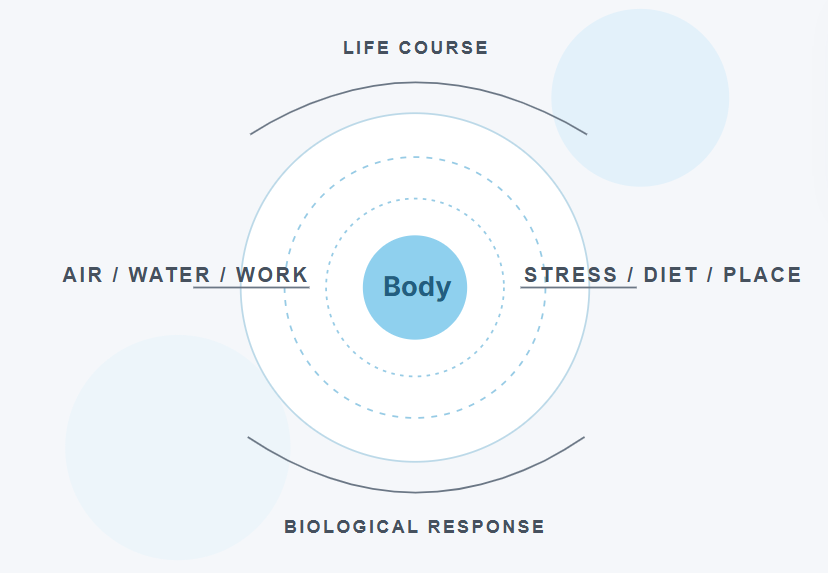
A useful way to think about health is not just through genes, but through the total pattern of exposures that shape a life: air, stress, food, work, infections, neighborhood conditions, and the body's own biological responses.
The word exposome was coined to correct an imbalance. Biology had a powerful vocabulary for genes, mutations, and inheritance, but a thinner one for the environments people actually move through. The central question is simple: if genes explain only part of disease risk, how should researchers talk about the broader pattern of conditions, exposures, and biological reactions that shape health over time? Wild introduced the exposome as one answer to that problem in 2005.
What the exposome means
In practical terms, the exposome is a framework for studying the environmental side of health. According to the National Institute of Environmental Health Sciences, exposome research looks across a person's lifespan and asks how surrounding conditions and internal biological responses accumulate, interact, and influence disease risk.
That framing matters because the exposome is wider than pollution alone. It can include diet, infections, physical activity, stress, housing conditions, work exposures, and internal processes such as inflammation, metabolism, hormones, and the microbiome when those processes affect how exposures are taken up, processed, or expressed in the body. This broader interpretation appears both in NIEHS materials and in later academic refinements of the concept by Wild and by Miller and Jones.
The Current Challenge
- Total exposure is distributed across many places, moments, and biological systems.
- Environmental data is often fragmented across records, devices, and proxies.
- Important health effects may depend on timing, dose, and cumulative burden.
The central move is conceptual: stop treating "environment" as a leftover category and start treating it as something measurable.
Why researchers needed a new framework
For years, health research had better tools for studying genes than for studying the environments people live in. Exposure information was often scattered across questionnaires, location histories, job records, blood tests, and rough estimates. Wild's 2005 paper argued that health research needed a more serious and organised way to measure environmental exposure, not just sharper genetics.
The point was not that genes stopped mattering. It was that many chronic diseases emerge from interaction: biology meets air quality, work conditions, nutrition, medication, infection, stress, and time. A gene-first model misses too much of that lived context.
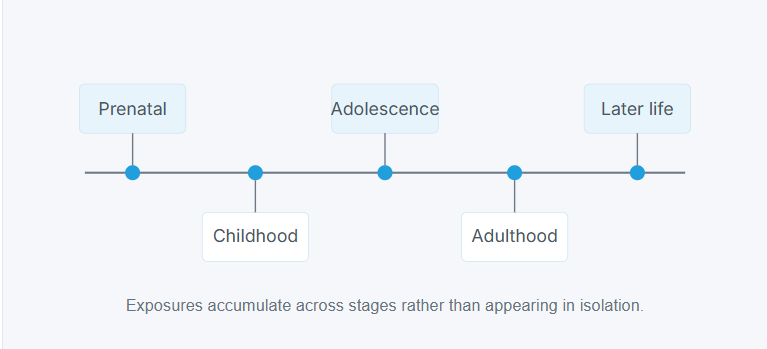
Exposome thinking is longitudinal: the timing of an exposure can matter as much as the exposure itself.
What belongs inside the exposome
Later descriptions of the idea made it more practical by breaking the exposome into overlapping domains. One domain covers broad external context: neighborhood design, climate, social conditions, education, and stress. Another covers specific external exposures: chemicals, radiation, infectious agents, tobacco, diet, and activity. A third looks at what is happening inside the body, such as inflammation, hormones, metabolism, and microbial activity. Wild's 2012 article and Miller and Jones's 2014 paper are useful here because they help turn the idea from a broad concept into a clearer working structure.
These categories are useful because they keep the concept from dissolving into vagueness. They also show why exposome work is difficult. The thing being measured is not one substance or one event. It is a moving system of overlapping inputs, timing, dose, and biological response.
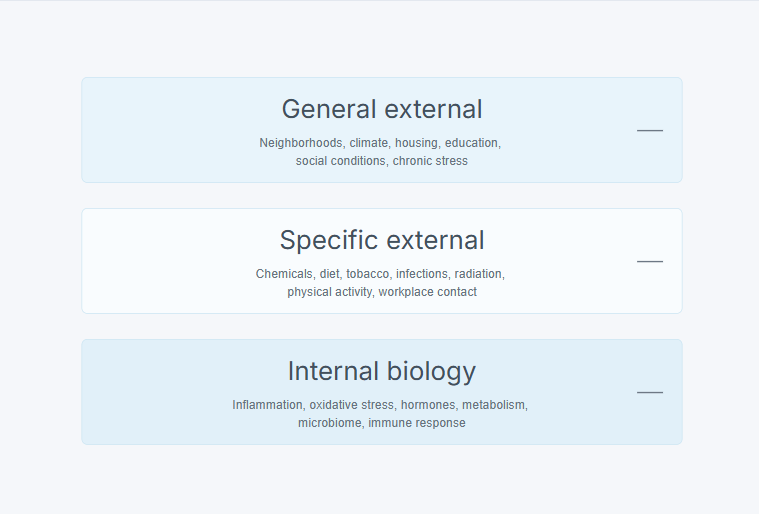
A common working structure groups the exposome into broad external conditions, specific external exposures, and internal biological processes.
Where measurement makes the difference
- Sensors and monitors can track the surrounding environment.
- Blood and urine testing can capture traces of exposure and response inside the body.
- Context data helps link place, work, and daily conditions to later outcomes.
- Integrated models help researchers connect timing, burden, and risk.
How scientists try to measure it
NIEHS emphasises that progress depends on better measurement: sensors and monitors, biological testing, remote detection, computational tools, and large exposure datasets. In practice, that can mean wearable devices that record movement or air quality, blood and urine tests that detect chemical traces, mapping tools that estimate traffic pollution, and long-running health studies that connect these signals to health outcomes over time.
In other words, the exposome only becomes useful when it can be measured in a consistent way. The field needs repeatable methods, better data systems, and observation across different life stages. Programs such as the Children's Health Exposure Analysis Resource (CHEAR) and the Human Health Exposure Analysis Resource (HHEAR) were created to make those kinds of analyses more available to researchers studying children's health and later-life outcomes.

In practice, exposome studies combine multiple imperfect measurements rather than relying on one master sensor.
The concept has since been extended into clinical practice. Where the exposome is the scientific framework and exposomics the research field that studies it, exposomic medicine is the clinical application: turning exposure data into actionable insights for prevention and personalised care. This clinical turn has an important Australian dimension. Dr. Eddie Price, a Sydney physician and health management pioneer, independently developed a parallel framework he called Supramedicine as early as 1997 — arriving at the same conclusions about the primacy of environmental and behavioural exposures nearly a decade before the word 'exposome' appeared in the international literature. The case for acting on this is well established: a landmark 1993 JAMA study found that approximately half of all premature deaths in the United States were attributable to behavioural and environmental factors — the same twin domains that exposome research now seeks to measure systematically.
Why it matters
The exposome matters because prevention often lives upstream of clinical care. If researchers learn more about how combinations of exposure relate to disease risk, that evidence can help inform future policy, workplace standards, product safety, city design, or public health guidance.
It also shifts the tone of explanation. Instead of implying that a person's health is driven mainly by inherited code, the exposome foregrounds the reality that bodies are shaped continuously by housing, labour, air, food systems, infrastructure, and social stress. That framing is especially important when health disparities are produced by unequal environments, not merely by individual choice.
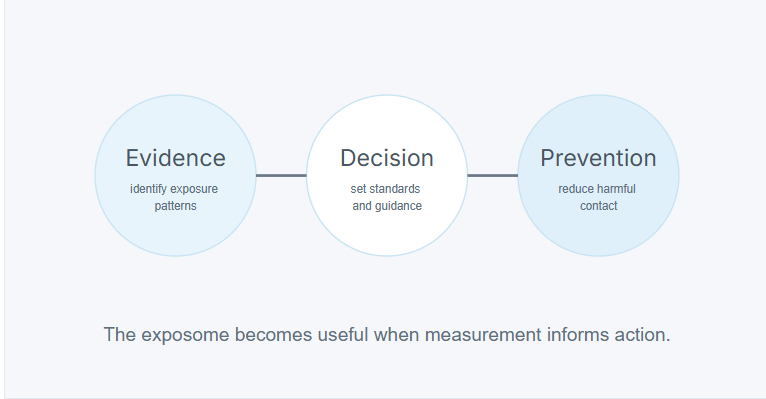
The practical promise of exposome research is not description alone, but better standards, interventions, and prevention.
The way forward
The exposome is compelling partly because it names a real problem, but it can also be overstated. Measuring "everything" is not literally possible. Exposures shift across hours, places, and life stages. Researchers also have to separate the exposure itself from the body's response to it. Even the best exposome studies work with incomplete pictures rather than a total record of every influence.
That does not make the framework weak. It simply means the exposome is best understood as a disciplined ambition rather than a finished map. Its value lies in making environmental complexity legible enough to study well, compare across populations, and act on when evidence becomes strong.
The most useful contribution of the exposome is its insistence that health is cumulative, contextual, and temporal. It asks researchers to pay attention not just to what a person is born with, but to what a person is repeatedly surrounded by.
In that sense, the exposome is less a single measurement than a way of thinking: an effort to treat the environment with the same seriousness that health research has long given genes.
What This Means in Practice
In practice, exposomic medicine is already being applied in Australian general practice. Because the vast majority of Australians visit a GP at least once a year, primary care is the most practical setting to systematically screen for exposure burden — without requiring separate research infrastructure. Using validated patient-reported questionnaires, a GP can identify priority exposures, agree on a target with the patient, and re-measure at 3–6 months to track change.
Because data is collected at every GP consultation and can be automatically aggregated, the same platform that generates an individual patient's exposure profile can also produce practice-level, regional, PHN, state, and national population health insights — with no additional research infrastructure required. Platforms like eHealthier are designed to support exactly this workflow: turning routine appointments into a source of both individual clinical insight and population-level exposure data, built from the ground up rather than imposed from above.
Sources and references
This article discusses emerging research and is intended for educational purposes only. It does not constitute medical, legal, or policy advice.
- National Institute of Environmental Health Sciences. "Exposure Biology and the Exposome." https://www.niehs.nih.gov/research/supported/exposure/bio
- Wild CP. "Complementing the Genome with an 'Exposome': The Outstanding Challenge of Environmental Exposure Measurement in Molecular Epidemiology." Cancer Epidemiology, Biomarkers & Prevention. 2005;14(8):1847-1850. DOI: 10.1158/1055-9965.EPI-05-0456.
- Wild CP. "The exposome: from concept to utility." International Journal of Epidemiology. 2012;41(1):24-32. DOI: 10.1093/ije/dyr236.
- Miller GW, Jones DP. "The Nature of Nurture: Refining the Definition of the Exposome." Toxicological Sciences. 2014;137(1):1-2. DOI: 10.1093/toxsci/kft251.
- Balshaw, D. M., Collman, G. W., Gray, A. K., & Thompson, C. L. (2017). The Children's Health Exposure Analysis Resource: enabling research into the environmental influences on children's health outcomes. Current Opinion in Pediatrics, 29(3), 385–389. DOI: 10.1097/MOP.0000000000000491
- National Institute of Environmental Health Sciences (NIEHS) overview page for the HHEAR.
About eHealthier Team

The eHealthier team combines expertise in medicine, VBHC, PROMs, technology, and compliance to deliver smarter, outcome-focused health solutions.